Monday, April 15, 2013

The Waubra Foundation, and Sarah Laurie

Seven things you must know about the Waubra Foundation and Sarah Laurie


The Waubra Foundation and Ms. Laurie misrepresent themselves as an independent and neutral agency in discussions of wind energy. They work to ensure that they are invited to testify at wind generation siting review boards around Australia and provide submissions to wind power siting reviews world wide.

However, they are not independent or trustworthy in their input and recommendations. There are seven key things you must be aware of and inform others of when dealing with the Waubra Foundation:
  1. They have no expertise and reject independent expertise and peer reviewed science
  2. They misrepresent themselves as well as the work of others
  3. They were formed by a coalition of NIMBY well-off landowners
  4. They are consistently unethical in their operations
  5. They are global warming deniers
  6. They have close ties to fossil fuel and mining interests opposed to wind energy
  7. They live nowhere near Waubra and the town is outraged at them

If they were just another biased advocacy group, the concern over their actions would not be as great. However, the strong evidence is that their actions are making people sick through stress and suggestion and they are preventing wind generation that is valuable in the fight against global warming.
 
Please read on for the evidence supporting each of these points.
 
1. The Waubra Foundation has no expertise and rejects peer-reviewed science
Ms Laurie dismisses the work related to wind energy of the Australian National Health and Medical Research Council (NHMRC) which performed an initial review in 2010 and is performing an in depth review at present. In February 2013 Ms Laurie told a planning panel (VCAT) that the Waubra Foundation won’t accept the NHMRC’s findings if they don’t agree with her view. This is unsurprising, as the Waubra Foundation has rejected the findings of 18 reviews from around the world including the NHMRC statement and very thorough reviews undertaken by Ontario, Massachusetts and Oregon health departments.
 
Ms Laurie has been caught misleading the public about her level of education by placing the letters MD behind her name (on her website and in public presentations) when she has not achieved this high-level medical research qualification, and has never published a piece of research. She has also claimed to be a fellow of two prominent medical fraternities 10 years after her membership lapsed. Sarah Laurie consistently uses the title Dr and calls herself a medical clinician, but has not practiced for more than 10 years. She has no medical research or epidemiological qualifications. She has claimed since 2010 that she is planning to re-register, however it is unlikely that she will do so anytime soon as it would bind her to professional standards that are incompatible with her current activities. In fact, she has been non-practicing and de-registered longer than she was practicing.
 
Ms Laurie has been disowned by experts she has claimed agree with her. At least three experts have demanded that she stop using their names, including Dr Peter Sharley (president, SA branch of the Australian Medical Association), Dr Andrew Lavendar (immediate past president, SA AMA) and Dr Liz Hanna (Public Health Association of Australia). Ms Laurie frequently quotes Dr Geoff Leventhall, a world authority on wind-turbine noise. Leventhall has said of her “I find it unwise to believe much of what Dr Laurie states, unless there is confirming evidence. She also misuses references, so that you have to be careful to check whether these are relevant and actually say what she claims they do.”

Ms Laurie invokes Carl V Philips as an expert on public health, ignoring the fact that his academic career came to an end as a result of him receiving large sums of money from the tobacco industry while finding that tobacco products just aren’t that harmful. 
 
Ms Laurie has appeared multiple times on Alan Jones’s radio show. Jones is the Sydney-based radio shock-jock who was ordered to undertake ‘factual accuracy training’ by the Australian Communications and Media Authority and whose advertisers abandoned him in 2012 for his ugly comments about the Prime Minister’s recently-deceased father. Ms Laurie is close to John Madigan, the senator for Victoria who thinks smart meters make people sick, opposes abortion even for the case of pregnancies as a result of rape, and hosted a tour of the swastika-bearing ‘Lord’ Christopher Monckton of Brenchley in February 2013. The Waubra Foundation has collaborated with Max Rheese, executive director of the anti-environment group, Australian Environment Foundation and the anti-climate science group Australian Climate Science Coalition.
 
Owing to her lack of appropriate qualifications, Ms Laurie was denied ‘expert witness’ status when she presented to the South Australian Environment, Resources and Development (ERD) Court in 2011. Dr Gary Wittert, Head of the Medical faculty at the University of Adelaide (and a registered physician) appeared as an expert and testified that “There is no credible evidence of a causal link, between the physical outputs of a turbine (or sets of turbines)… and adverse effects on health.” Dr Wittert testified that the data presented by Ms Laurie did not support her hypothesis that high blood pressure was related to turbine operation. The ERD ultimately found Ms Laurie’s testimony unconvincing. Ms Laurie was also not allowed to appear as an expert witness at the Cherry Tree Wind Farm hearing in February 2013.

Ms Laurie is becoming infamous for her devotion to pseudoscience. She is listed on QuackWatch, a site cataloging purveyors of questionable methods and/or advice. She is a nominee for the Australian Skeptics’ 2013 Bent Spoon Award, an award presented to the “perpetrator of the most preposterous piece of paranormal or pseudo-scientific piffle”. She and the Waubra Foundation are listed on the Centre For Media and Democracy’s SourceWatch website, a site documenting the world’s fake grassroots (‘astroturf’) groups.
 
Science doesn’t agree with the Waubra Foundation. There’s not a single peer-reviewed scientific paper in any credible journal that supports the Waubra Foundation’s position that infrasound from wind turbines makes people sick. A credible scientific paper requires that the paper is subject to the normal academic process of peer review then published in journal that is ranked, indexed by PubMed and has a reasonable impact factor. One of the papers most quoted by Ms Laurie, the Nissenbaum paper in Noise and Health, was authored by a veterinarian, a radiologist and an anesthetist who have been long-time anti wind activists. The paper has been thoroughly discredited in two separate Letters to the Editor. The Waubra Foundation often points to a series of articles that support their position in the Bulletin of Science and Technology, yet fails to mention that the journal is an unindexed hobby journal of a cross-disciplinary Associate Professor who publishes it irregularly.

The two acousticians relied upon by the Waubra Foundation refuse to subject their work to public scrutiny. Robert Thorne and Steven Cooper have both refused multiple requests to provide copies of their reports and data or to present their work to their peers for review.
 
The Waubra Foundation embraces pseudo-science. As well as nonsensical comments about infrasound (which is all around us at levels above those generated by wind turbines), the Foundation believes that wind turbines possibly subject people to airborne ‘stray voltages’, electromagnetic fields (EMF), “ground-borne vibrations, rapid fluctuations in barometric pressure [...] at times with sufficient energy to perceptibly rock stationary cars even further than a kilometer away from the nearest wind turbine”. The Foundation is unable to substantiate these claims.
 
There’s not a single medical authority or notable medical researcher in Australia or the world that agrees with the Waubra Foundation. After three years of activism in Australia, the Waubra Foundation has managed to find just four general practitioners, one pharmacist, one sleep physician and one psychologist out of the 528,000 registered health practitioners in Australia to support their claims. While the Foundation cannot count a single qualified and reputable medical expert, the South Australian EPA, WorkSafe, the Victorian Chief Medical Officer and the NSW Department of Health and the NHMRC have all determined that there is no scientific support for their claims. The Climate and Health Alliance, a coalition of 20 groups including the Royal Australasian College of Physicians and the Australian Psychological Society, has stated that there is no credible evidence in peer-reviewed scientific journals linking turbines to illness.

2. The Waubra Foundation misrepresents itself and others constantly
Ms Laurie frequently misrepresents published scientific reports. She claims that NASA research has shown infrasound to be harmful, however neglects to mention that they were researching levels 1,000,000 times higher. She claims the articles in the Bulletin of Science and Technology are credible and peer-reviewed. And closer to home, when the South Australian EPA monitored infrasound she claimed that it hadn’t measured frequencies below 10 Hz. When it was pointed out to her that the EPA did in fact measure below 10 Hz (down to 0.25 Hz), she admitted that she hadn’t read the report closely.
 
The Waubra Foundation makes up its numbers. Ms Laurie has variously claimed that “a number of people”, “more than 20 families”, “more than 40 households” etc., have left their farms in Australia because they are ‘wind turbine refugees’. Putting aside the question of appropriateness of using the term refugee, Sarah is unwilling and unable to provide evidence to substantiate these claims.
 
The Waubra Foundation gags on so-called ‘gag clauses’. Ms Laurie claims that many people have been made sick by wind turbines but can’t tell anyone about it because they are legally prevent from doing so. Wind developers have made it clear that they do not, and cannot legally, prevent anyone from reporting health impacts. Ms Laurie has been challenged to provide an example of individuals who have been gagged, but is unable to do so. When so-called gag clauses are shown, they are early leasing contracts with language ensuring that competitors are not told of the leasing agreement; this is standard business language.
 
The Waubra Foundation is an anti-wind activist organisation yet Ms. Laurie frequently claims that she and the Waubra Foundation are not anti-wind. As well as health issues, Ms Laurie has raised bogus concerns about fire risk, property values and the effectiveness of turbines to abate carbon pollution (all of which have been refuted by experts and/or research with integrity). The Waubra Foundation has co-authored documents with NAPAW and EPAW, two alliances of northern hemisphere anti-wind groups. Ms Laurie frequently comments on the anonymous and defamatory blog stopthesethings.com and participates in discussions on windturbinesyndrome.com. Both blogs reject dissenting comments. She regularly submits her comments and articles to the anti-wind blog wind-watch.org.
 
The Waubra Foundation wants more research, but can’t say what such research would look like. Ms Laurie has repeatedly advocated for a moratorium on wind energy until such time as some unspecified research has been done. At no time has the WF publicly suggested a research methodology. The evidence suggests that this is a strategy not to improve health outcomes, but to construct barriers to the further development of wind energy.

3. The Waubra Foundation is a NIMBY organization
The Waubra Foundation’s directors are NIMBYs. Ms Laurie objected to the Crystal Brook Wind Farm near her country home. Kathy Russell objected to the Mount Pollock Wind Farm near her home. Peter Mitchell objected to the Stockyard Hill Wind Farm near his country estate. Michael Wooldridge objected to the Bald Hills Wind Farm near his home. Tony Hodgson objected to the Collector Wind Farm near his country home.
 
Ms. Laurie has agreed under testimony to an Australian Environment Review and Development court in 2011 that she was motivated by a wind generation site proposed near her home in Crystal Brook, Australia.
 
Mr Mitchell claims to be one of Australia’s first genuine wind farm refugees. In 2009 he claimed that he was forced to leave his country estate because of the Stockyard Hill Wind Farm, even though the wind generation site hadn’t be built and won’t be until the second half of this decade.
 
Mr Mitchell has dedicated considerable time and money to fighting the proposed wind generation site. Mr Mitchell’s activities include setting up fake grassroots campaigns, preparing/presenting anti-wind submissions for government inquiries and public meetings and establishing the Waubra Foundation. Mr Mitchell has enlisted his family to help drive his anti-wind generation agenda. His daughter Cassie Franzose chairs the Western Plains Landscape Guardians and was founding Public Officer of the Australian Landscape Guardians. The Australian Landscape Guardians is registered to the address of his family estate. His wife, son, daughter, nieces, his sister and sister’s partner, Tim Orr, are all registered objections to the Stockyard Hill Wind Farm. Tim Orr also set up a company, Windburst Publishing, that publishes anti-wind power documents.
 
Mr Mitchell told VCAT in 2013 that he felt unwelcome in the local town, presumably a result of the dirty tricks employed to secure the removal of 70 wind turbine towers from his neighbours which removed approximately $1 million from the local economy over the life of the site.
 
As a refugee, he has been forced to live hand-to-mouth in one of his several other luxury residences in Australia.

4. The Waubra Foundation is consistently unethical
The Waubra Foundation exploits the vulnerable to do its dirty work. Ms Laurie maintains a roster of people who believe that wind turbines have made them sick. One believes that there is “too much electricity in his skull” and that his mobile phone switches to charge mode when he’s near wind turbines. Another started taking medication to alleviate symptoms, five years before the wind farm started operation. Another believes that wind turbines are creating electric fields in her house that are making her sick. Some have reported suicidal ideation. Rather than reassuring these individuals and referring them to appropriate help, the Waubra Foundation introduces them to the media, puts them up for anti-wind meetings and publishes video of their stories. Ms Laurie has a conflict of interest — the more her subjects’ health deteriorates, the more successful she becomes.
 
The Waubra Foundation is a front group for the Landscape Guardians, a loose collection of anti-wind groups. WF Director Kathy Russell is Vice President of the Australian Landscape Guardians (ALG), spokeswoman for Western Plains Landscape Guardians (WPLG), Mt. Pollock Landscape Guardians and the Barrabool Hills Landscape Guardians. WF Chairman Mr Mitchell has been spokesperson for the ALG and WPLG. WF Director Tony Hodgson is the founder of Friends of Collector, a group functionally identical to a Landscape Guardians franchise.
 
The Waubra Foundation is in breach of its constitution. The objectives of the WF state that it must “at all times maintain complete independence from government, industry and advocacy groups for or against wind turbines”, yet five of its directors are long time anti-wind activists and the foundation maintains strong links with anti-wind groups such as the Landscape Guardians, the (misleadingly named) Australian Environment Foundation, NAPAW, EPAW and National Wind Watch.
 
The Waubra Foundation is not transparent and misuses its tax-free donations. The foundation registered as a charity in 2010 but has not published its annual accounts or disclosed where its donations come from. When interviewed by ABC Ballarat, Ms Laurie said the funding comes from farmers. When pressed by the interviewer, she admitted that Peter Mitchell was one of those ‘farmers’. The foundation has sought tax deductible donations to fund litigation and noise monitoring, activities that are not appropriate for a health promotion charity.

The Waubra Foundation refuses to meet with wind developers. Hepburn Wind, a community wind co-operative in central Victoria has tried to engage with the Waubra Foundation in order to get to the bottom of Ms Laurie’s claims. Ms Laurie has steadfastly refused to meet, has hung up on members of the organisation and generally ignores emails — not the conduct of a medical professional working to achieve good outcomes for the community.
 
The Waubra Foundation rejects relevant peer-reviewed published research. Despite making frequent public statements that are likely to cause considerable anxiety and distress about wind farms, and frequently interacting with people so affected, the Foundation dismisses out out-of-hand recent published research that shows anti-wind activism has the potential to induce symptoms in some members of the community (the ‘nocebo’ effect).
 
The Waubra Foundation violates medical ethics and regulatory standards. Ms Laurie’s clinical contact with individuals, attempted collection of private patient data from the Ballarat Base Hospital, provision of advice to health practitioners and various publications are in contravention of the NHMRC’s National Statement on Ethical Conduct in Human Research ethics as well as published guidelines and regulations of the Medical Board of Australia and Australian Health Practitioner Regulation Agency.
Professor Simon Chapman and Fiona Crichton led teams of researchers in Sydney and Auckland recently who published findings showing clearly that health complaints from wind generation are due to anti-wind campaigners creating fear and stress and inducing symptoms via the nocebo effect. Ms. Laurie, as a former medical practitioner, has ignored those studies despite clear statements directly to her that she is causing people to fall ill. She continues to promote unfounded health fears which will make people sick.

5. The Waubra Foundation denies that global warming is occurring
With 97%+ of climate scientists supporting the reality that man-made carbon emissions are on track to heat the planet to dangerous levels, Ms Laurie, Mr Mitchell and Ms Russell have publicly stated their doubts about climate science.
In a recent radio interview with a European ex-pat oriented radio station, Ms. Laurie again claimed that there were realistic doubts about global warming and mankinds part in it.

6. The Waubra Foundation has close ties to fossil fuel and mining interests opposed to wind energy
Founder and Chairman Peter Mitchell has deep, decades-long and on-going financial involvement with fossil fuels and uranium companies. Mr Mitchell failed to disclose this in his statement of interests to the National Health and Medical Research Council (NHMRC). Mitchell has written several unpublished, un-reviewed papers aimed at convincing the reader that wind farms do not reduce carbon pollution.
 
The Waubra Foundation is run out of Peter Mitchell’s office in South Melbourne, the same office as his fossil fuel interests. Mr Mitchell’s long time assistant, Susan Richmond (a.k.a. Susan Ghent) has been involved with Mr Mitchell’s business affairs since at least 1986, is a founding member of the WF, registered their internet domain name and provides administrative support for the WF. Until recently the WF shared a PO Box with the Western Plains Landscape Guardians and Mitchell’s investment company, however, after taking heat in the media about this it has recently moved to a PO Box close to Ms Richmond’s home.

7. Waubra Foundation Directors live far from Waubra and the town is outraged at them
None of the Foundation’s directors live anywhere near the town of Waubra. Ms Laurie lives 668 km from Waubra, Mr Mitchell 122 km, Clive Tadgell 135 km, Kathy Russell 127 km, Tony Hodgson 793 km and Michael Wooldridge 141 km.
 
The town of Waubra is outraged that their name has been used for political purposes. Many in the town are livid that their name is associated with the Foundation. While some of Ms. Laurie’s first and most fanatical supporters live in Waubra, most town members have a positive association with their town’s name. Ms Laurie has never attended the annual Waubra Festival that, in part, celebrates the local wind farm.

Summary:
Sarah Laurie and the Waubra Foundation are anti-wind campaigners that deny global warming, have strong ties to the fossil fuel industry, misrepresent and deny science, have the ethical standards of a tobacco PR rep and are causing people to fall ill.
Yet they claim the inverse. And they claim to be neutral, independent advisors to wind generation siting decisions. Their misrepresentation of themselves is Orwellian in its reversal of the truth.

Friday, April 12, 2013

Avian Mortality: A Look at the Evidence

Bird death and wind turbines: a look at the evidence

10 Apr 2013, 16:30
Robin Webster and Freya Roberts

The Royal Society for the Protection of Birds (RSPB) and windfarm opponents have found themselves at odds over the risk turbines pose to bird species, particularly birds of prey. Carbon Brief examines what the peer-reviewed research says about turbines' impacts on birds.

An article in last weekend's Mail on Sunday claims wind farms are "destroying rare birds", arguing turbines kill birds of prey including hen harriers and golden eagles. And in another piece, the Telegraph says a US-based conservation group fears windfarms will "massacre" eagles.

But in a response to the claims, the RSPB's conservation director, Martin Harper, says a large body of scientific evidence shows "appropriately located windfarms have negligible impacts" on bird populations.
 
Why birds are affected
There are reasons why birds are likely to be affected by windfarms. Wind developments tend to be placed in upland areas with strong wind currents that have a lot of potential to generate energy. Birds - particularly raptors like eagles or vultures - use these currents as highways - and so are likely to come into contact with the turbines.

It's not just the turbine blades that pose a risk to birds; research indicates that wind developments can disrupt migration routes. What's more, foraging and nesting habitat can also be lost when turbines are put up.

What's the impact on bird populations?
Despite these concerns, the current body of research suggests windfarms have not significantly reduced bird populations.

Several studies suggest birds have the ability to detect wind turbines in time and change their flight path early enough to avoid them. And one small study found no evidence for sustained decline in two upland bird species on a windfarm site after it had been operating for three years. Another found that wild geese are able to avoid offshore wind turbines.

A large peer-reviewed study in the Journal of Ecology monitored data for ten different bird species across 18 wind farm sites in the UK. It found that two of them- curlew and snipe - saw a drop in population during the construction phase, which did not recover afterwards. But the population of the other eight species were restored once the windfarms were built.

Wind turbines and birds of prey
Windfarms may not affect all birds, but what if they affect birds of prey disproportionately? Some of the reason why this might happen is genetic - certain species like vultures, for example, have blind spots in their visual field which mean they cannot see objects directly in front of them (like wind turbines) when flying.

Large birds like hen harriers, eagles and vultures are also slower to reproduce than other species and so their populations are more likely to be affected by a small number of deaths.

There are specific locations elsewhere in the world where windfarms have caused impressive-sounding numbers of fatalities amongst birds of prey. In the Altamont Pass in California, for example, one study found about 4,000 wind turbines killed 67 golden eagles and 1,127 birds of prey in a year.

In southern Spain, 252 wind turbines located in an area used by many birds of prey and on the migratory path of many large birds killed a 124 birds of prey in a year. At another location in southern Spain 256 turbines killed 30 griffin vultures and 12 common kestrels.

The RSPB references these studies, concluding "some poorly sited wind farms" in California and Spain have caused major bird casualties - in other words the windfarms were sited in areas where there were a lot of birds and not enough thought given to what the effects will be on bird populations. But it adds that these are atypical and a result of bad planning in sensitive areas -arguing that better-sited windfarms do not cause the same number of deaths.

Siting of wind farms
What evidence is the RSPB relying on? There are studies to show that siting windfarms more sensitively can make a difference to how bird populations adapt to their new neighbours. In one frequently cited study, one windfarm in Spain created feeding sites away from turbines and shut down turbines at peak flight times. Vulture deaths were reduced by 50 per cent for an electricity production loss of just 0.07 per cent.

The RSPB's parent group Birdlife International describes another project in Wyoming. Windfarms located on a flight path used by golden eagles and hawks posed a "serious threat", it says. But the turbines were set back slightly - with the result that ultimately very few birds are killed.

According to Birdlife International, with a thorough environmental assessment as part of the planning process, bird deaths can be significantly reduced. In Scotland for example, planners use maps to identify high risk areas for protected birds. Some wind farms, such as the Penescal windfarm in Texas, use radar systems to detect flocks of birds and shut off the wind turbines as they approach.

Overall, the RSPB says it scrutinises "hundreds" of windfarm applications every year in order to assess their possible impact on wildlife and bird populations and ultimately objects to six per cent of them.

A comparison of deaths - what else kills birds?
Lots of human activities kill birds. What's perhaps surprising, given the amount of attention it gets, is how few birds wind turbines kill in relation to other things.

Several studies have compared the effect of different energy sources on bird mortality overall. One, published earlier this year, calculates windfarms killed 20,000 birds in 2009 in the US - while nuclear plants killed about 330,000 and fossil fueled power plants more than 14 million. The research concludes that taken together, fossil-fueled facilities are about 17 times more dangerous per gigawatt hour of electricity produced to birds than wind and nuclear power stations.

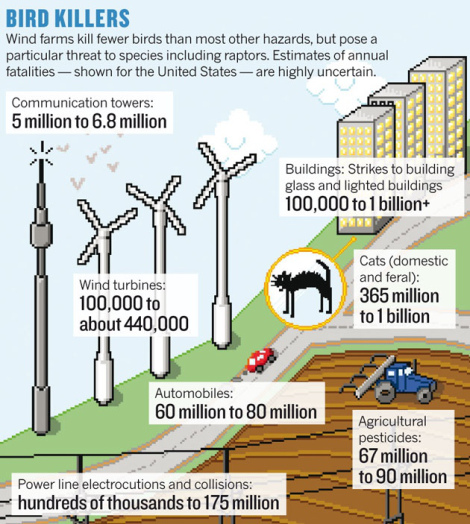
And that's without getting into other human activities and structures - including buildings, roads and domestic cats. US estimates published last year in a commentary piece in the journal Nature, although highly uncertain, also suggest the impact of wind turbine is far smaller than many other causes of bird death:

Nature Image

The RSPBsays it supports wind power - not because windfarms pose a lower risk to birds than other energy sources - but because in its view climate change poses the "single greatest long-term threat" to bird species. Climate change is predicted to harm bird populations by affecting breeding or migration patterns, or altering their habitats.

There is evidence to show that in certain, specific locations windfarms have caused significant fatalities amongst birds of prey- but there doesn't seem to be any evidence supporting the conclusion that birds of prey will be 'massacred' on a wider scale. The few studies on windfarm siting are also encouraging, indicating that it can be used as an effective tool to reduce mortality. Compared to other aspects of modern society, careful planning can lead to much-reduced mortality.

Seventeen Reviews, One Common Conclusion


Summary of main conclusions reached in 17 reviews of the research literature on wind farms and health.
Compiled by Prof Simon Chapman, School of Public Health and Teresa Simonetti, Sydney University Medical School 30 Jan 2012
2012: Massachusetts Department of Environmental Protection. Independent Expert Science Panel Releases Report on Potential Health Effects of Wind Turbineshttp://www.mass.gov/dep/public/press/0112wind.htm

2012: Oregon Wind Energy Health Impact Assessment.
http://public.health.oregon.gov/HealthyEnvironments/TrackingAssessment/HealthImpactAssessment/Documents/Oregon%20Wind%20Energy%20HIA%20Public%20comment.pdf


2011: Fiumicelli D. Windfarm noise dose-response: a literature review. Acoustics Bulletin 2011; Nov/Dec:26-34
[copies available from simon.chapman@sydney.edu.au)

2011: Bolin K et al. Infrasound and low frequency noise from wind turbines: exposure and health effects. Environmental Res Let 2011;
http://iopscience.iop.org/1748-9326/6/3/035103/

2010: Knopper LD, Ollsen CA. Health effects and wind turbines: a review of the literature. Environmental Health 2010;
http://www.ehjournal.net/content/10/1/78

2010: UK Health Protection Agency Report on the health effects of exposure to
ultrasound and infrasound
http://www.hpa.org.uk/web/HPAwebFile/HPAweb_C/1265028759369

2010: UK Health Protection Agency. Environmental noise and health in the UK. A report by the Ad Hoc Expert Group on Noise and Health. (this report is about all environmental noise)

http://www.hpa.org.uk/webc/HPAwebFile/HPAweb_C/1279888026747

2010: NHMRC Rapid Review of the evidence
http://www.nhmrc.gov.au/_files_nhmrc/publications/attachments/new0048_evidence_review_wind_turbines_and_health.pdf

2010: Chief Medical Officer of Health in Ontario
http://www.health.gov.on.ca/en/public/publications/ministry_reports/wind_turbine/wind_turbine.pdf

2009: Minnesota Department of Health. Environmental Health Division. Public
Health Impacts of Wind Turbines.http://www.health.state.mn.us/divs/eh/hazardous/topics/windturbines.pdf

2009: Colby et al. Wind Turbine Sound and Health Effects: An Expert Panel Review.
http://199.88.77.35/EFiles/docs/CD/PlanCom/10_0426_IT_100416160206.pdf


2009: Context and Opinion Related to the Health Effects of Noise Generated by WindTurbines. Agence Française de Sécurité Sanitaire de l’Environnement et du Travail (Affset).
http://www.inspq.qc.ca/pdf/publications/1015_EoliennesSantePublique.pdf

2008: Chatham-Kent Public Health Unit.
http://www.harvestingwindsupport.com/blog/wpcontent/uploads/2011/03/Chatham-KentHealth-and-Wind-.pdf


2007: National Research Council (USA): Impact of wind energy development on humans (Chapter 4: pp97-120) of: Environmental Impacts of Wind-Energy Projects.
http://www.vawind.org/assets/nrc/nrc_wind_report_050307.pdf

2005: Jakobsen J. Infrasound emission from wind turbines. J Low Frequency Noise, Vibration and Active Control 2005; 24(3):145-155

2004: Leventhall G. Low frequency noise and annoyance. Noise & Health
http://tinyurl.com/4yc3oht

2003: Eja Pedersen’s Review for the Swedish EPA
http://www.naturvardsverket.se/Documents/publikationer/620-5308-6.pdf

Reviews of the evidence - extracted highlights


Direct health effects from noise and WTS

There are no direct pathological effects from wind farms and that any potential impact on humans can be minimised by following existing planning guidelines.” Source: NHMRC
http://www.nhmrc.gov.au/_files_nhmrc/publications/attachments/new0048_evidence_review_wind_turbines_and_health.pdf
There is no evidence that the audible or sub-audible sounds emitted by wind turbines have any direct adverse physiological effects.”
Source: Colby 2009 review
http://199.88.77.35/EFiles/docs/CD/PlanCom/10_0426_IT_100416160206.pdf

There is insufficient evidence that the noise from wind turbines is directly... causing health problems or disease.”
Source: Massachusetts review
http://www.mass.gov/dep/energy/wind/turbine_impact_study.pdf


“There is no reason to believe, based on the levels and frequencies of the sounds and...sound exposures in occupational settings, that the sounds from wind turbines could plausibly have direct adverse health consequences.”
Source: Colby 2009 review
http://199.88.77.35/EFiles/docs/CD/PlanCom/10_0426_IT_100416160206.pdf

...while some people living near wind turbines report symptoms such as dizziness, headaches, and sleep disturbance, the scientific evidence available to date does not demonstrate a direct causal link between wind turbine noise and adverse health effects. The sound level from wind turbines at common residential setbacks is not sufficient to cause hearing impairment or other direct health effects.."
Source: Ontario CMOH Report
http://www.health.gov.on.ca/en/public/publications/ministry_reports/wind_turbine/wind_turbine.pdf

...the audible noise created by a wind turbine, constructed at the approved setback distance does not pose a health impact concern.”
Source: Chatham-Kent Public Health Unit
http://www.harvestingwindsupport.com/blog/wpcontent/uploads/2011/03/Chatham-KentHealth-and-Wind-.pdf

"There is no evidence for a set of health effects, from exposure to wind turbines that could be characterized as a "Wind Turbine Syndrome."
Source: Massachusetts review
http://www.mass.gov/dep/energy/wind/turbine_impact_study.pdf


...there is not an association between noise from wind turbines and measures of psychological distress or mental health problems.”
Source: Massachusetts review
http://www.mass.gov/dep/energy/wind/turbine_impact_study.pdf


Evidence that environmental noise damages mental health is… inconclusive.”
Source:Ad Hoc Expert Group on Noise and Health
http://www.hpa.org.uk/webc/HPAwebFile/HPAweb_C/1279888026747


To date, no peer reviewed scientific journal articles demonstrate a causal link
between people living in proximity to modern wind turbines, the noise (audible, low frequency noise, or infrasound) they emit and resulting physiological health effects.”
Source: Knopper&Ollson review
http://www.ehjournal.net/content/pdf/1476-069X-10-78.pdf

...there is no scientific evidence that noise at levels created by wind turbines could cause health problems other than annoyance...”
Source: Eja Pedersen 2003 Review
http://www.naturvardsverket.se/Documents/publikationer/620-5308-6.pdf

None of the... evidence reviewed suggests an association between noise from wind turbines and pain and stiffness, diabetes, high blood pressure, tinnitus, hearing impairment, cardiovascular disease, and headache/migraine.”
Source: Massachusetts review
http://www.mass.gov/dep/energy/wind/turbine_impact_study.pdf

...there are no evidences that noise from wind turbines could cause cardiovascular and psycho-physiological effects.”
Source: Eja Pedersen 2003 Review
http://www.naturvardsverket.se/Documents/publikationer/620-5308-6.pdf

“…there was no evidence that environmental noise was related to raised blood pressure…”
Source: Ad Hoc Expert Group on Noise and Health
http://www.hpa.org.uk/webc/HPAwebFile/HPAweb_C/1279888026747

The health impact of the noise created by wind turbines has been studied and debated for decades with no definitive evidence supporting harm to the human ear.”
Source: Chatham-Kent Public Health Unit
http://www.harvestingwindsupport.com/blog/wpcontent/uploads/2011/03/Chatham-KentHealth-and-Wind-.pdf
The electromagnetic fields produced by the generation and export of electricity from a wind farm do not pose a threat to public health...”
Source: NHMRC 2010
http://www.nhmrc.gov.au/_files_nhmrc/publications/attachments/new0048_evidence_review_wind_turbines_and_health.pdf
...no consistent associations were found between wind turbine noise exposure and symptom reporting, e.g. chronic disease, headaches, tinnitus and undue tiredness.”
Source: Bolin et al 2011 Review
http://iopscience.iop.org/1748-9326/6/3/035103/pdf/1748-9326_6_3_035103.pdf

...low level frequency noise or infrasound emitted by wind turbines is minimal and of no consequence... Further, numerous reports have concluded that there is no evidence of health effects arising from infrasound or low frequency noise generated by wind turbines.”
Source: NHMRC 2010
http://www.nhmrc.gov.au/_files_nhmrc/publications/attachments/new0048_evidence_review_wind_turbines_and_health.pdf

...renewable energy generation is associated with few adverse health effects compared with the well documented health burdens of polluting forms of electricity generation...”
Source: NHMRC 2010http://www.nhmrc.gov.au/_files_nhmrc/publications/attachments/new0048_evidence_review_wind_turbines_and_health.pdf
Although opposition to wind farms on aesthetic grounds is a legitimate point of view, opposition to wind farms on the basis of potential adverse health consequences is not justifiedby the evidence.”
Source: Chatham-Kent Public Health Unit
http://www.harvestingwindsupport.com/blog/wpcontent/uploads/2011/03/Chatham-KentHealth-and-Wind-.pdf

What is apparent is that numerous websites have been constructed by individuals or groups to support or oppose the development of wind turbine projects, or media sites reporting on the debate. Often these websites state the perceived impacts on, or benefits to, human health to support the position of the individual or group hosting the website. The majority of information posted on these websites cannot be traced back to a scientific, peer-reviewed source and is typically anecdotal in nature. In some cases, the information contained on and propagated by internet websites and the media is not supported, or is even refuted, by scientific research. This serves to spread misconceptions about the potential impacts of wind energy on human health...”
Source: Knopper&Ollson review
http://www.ehjournal.net/content/pdf/1476-069X-10-78.pdf


Annoyance

wind turbine noise is comparatively lower than road traffic, trains,construction activities, and industrial noise.”Source: Chatham-Kent Public Health Unit
http://www.harvestingwindsupport.com/blog/wpcontent/uploads/2011/03/ChathamKentHealth-and-Wind-.pdf

The perception of noise depends in part on the individual - on a person’s hearing acuity and upon his or her subjective tolerance for or dislike of a particular type of noise. For example, a persistent“whoosh” might be a soothing sound to some people even as it annoys others.”
Source: NRC 2007
http://www.vawind.org/assets/nrc/nrc_wind_report_050307.pdf

...some people might find [wind turbine noise annoying. It has been suggested that annoyance may be a reaction to the characteristic“swishing” or fluctuating nature of wind turbine sound rather than to the intensity of sound.”
Source: Ontario CMOH Report
http://www.health.gov.on.ca/en/public/publications/ministry_reports/wind_turbine/wind_turbine.pdf

“… being annoyed can lead to increasing feelings of powerlessness and frustration, which is widely believed to be at least potentially associated with adverse health effects over the longer term.”
Source: Ad Hoc Expert Group on Noise and Health
http://www.hpa.org.uk/webc/HPAwebFile/HPAweb_C/1279888026747

Wind turbine annoyance has been statistically associated with wind turbine noise, but found to be more strongly related to visual impact, attitude to wind turbines and sensitivity to noise.”
Source: Knopper&Ollson review
http://www.ehjournal.net/content/pdf/1476-069X-10-78.pdf

The annoyance caused by wind turbine sound has been linked to sound levels and other factors, specifically wind turbine visibility and the attitude of individuals exposed to them”
http://www.inspq.qc.ca/pdf/publications/1015_EoliennesSantePublique.pdf

...self reported health effects like feeling tense, stressed, and irritable, were associated with noise annoyance and not to noise itself...”
Source: Knopper&Ollson review
http://www.ehjournal.net/content/pdf/1476-069X-10-78.pdf

...many of the self reported health effects are associated with numerous issues, many of which can be attributed to anxiety and annoyance.”
Source: Knopper&Ollson review
http://www.ehjournal.net/content/pdf/1476-069X-10-78.pdf

To date, no peer reviewed articles demonstrate a direct causal link between people living in proximity to modern wind turbines, the noise they emit and resulting physiological health effects. If anything, reported health effects are likely attributed to a number of environmental stressors that result in an annoyed/stressed state in a segment of the population.”
Source: Knopper&Ollson review
http://www.ehjournal.net/content/pdf/1476-069X-10-78.pdf

“… some community studies are biased towards over-reporting of symptoms because of an explicit link between…noise and symptoms in the questions inviting people to remember and report more symptoms because of concern about noise.”
Source: Ad Hoc Expert Group on Noise and Healthhttp://www.hpa.org.uk/webc/HPAwebFile/HPAweb_C/1279888026747

The major source of uncertainty in our assessment is related to the subjective nature of response to sound, and variability in how people perceive, respond to, and cope with sound.”
Source: Oregon review
http://public.health.oregon.gov/HealthyEnvironments/TrackingAssessment/HealthImpactAssessment/Documents/Oregon20Wind20Energy20HIA20Public20comment.pdf

...sleep difficulties, as well as feelings of uneasiness, associated with noise annoyance could be an effect of the exposure to noise, although it could just as well be that respondents with sleeping difficulties more easily appraised the noise as annoying.”
Source: NHMRC 2010
http://www.nhmrc.gov.au/_files_nhmrc/publications/attachments/new0048_evidence_review_wind_turbines_and_health.pdf

Even noise that falls within known safety limits is subjective to the recipient and will be received and subsequently perceived positively or negatively.”
Source: Chatham-Kent Public Health Unit
http://www.harvestingwindsupport.com/blog/wpcontent/uploads/2011/03/Chatham-KentHealth-and-Wind-.pdf

...annoyance was strongly correlated with a negative attitude toward the visual impact of wind turbines on the landscape...”
Source: NHMRC 2010
http://www.nhmrc.gov.au/_files_nhmrc/publications/attachments/new0048_evidence_review_wind_turbines_and_health.pdf

Respondents tended to report more annoyance when they also noted a negative effect on landscape, and ability to see the turbines was strongly related to the probability of annoyance.”
Source: Minnesota Health Dept 2009
http://www.health.state.mn.us/divs/eh/hazardous/topics/windturbines.pdf

It is proposed that annoyance is not a direct health effect but an indication that a person’s capacity to cope is under threat. The person has to resolve the threat or their coping capacity is undermined, leading to stress related health effects... Some people are very annoyed at quite low levels of noise, whilst other are not annoyed by high levels.”
Source: NHMRC 2010
http://www.nhmrc.gov.au/_files_nhmrc/publications/attachments/new0048_evidence_review_wind_turbines_and_health.pdf

Further, sounds, such as repetitive but low intensity noise, can evoke different responses from individuals… Some people can dismiss and ignore the signal, while for others, the signal will grow and become more apparent and unpleasant over time…These reactions may have little relationship to will or intent, and more to do with previous exposure history and personality.”
Source: Minnesota Health Dept 2009
http://www.health.state.mn.us/divs/eh/hazardous/topics/windturbines.pdf

Stress and annoyance from noise often do not correlate with loudness. This may suggest [that other factors impact an individual’s reaction to noise… individuals with an interest in a project and individuals who have some control over an environmental noise are less likely to find a noise annoying or stressful.”
Source: Minnesota Health Dept 2009
http://www.health.state.mn.us/divs/eh/hazardous/topics/windturbines.pdf

There is a possibility of learned aversion to low frequency noise, leading to annoyance and stress...”
Source: Leventhall 2005 review
http://www.noiseandhealth.org/article.asp?issn=14631741;year=2004;volume=6;issue=23;spage=59;epage=72;aulast=Leventhall

Noise produced by wind turbines generally is not a major concern for humans beyond a half mile or so because various measures to reduce noise have been implemented in the design of modern turbines.”
Source: NRC 2007
http://www.vawind.org/assets/nrc/nrc_wind_report_050307.pdf

Noise…levels from an onshore wind project are typically in the 35-45 dB(A) range at a distance of about 300 meters... These are relatively low noise or sound-pressure levels compared with other common sources such as a busy office (~60 dB(A)), and with night time ambient noise levels in the countryside ( ~20-40 dB(A)).”
Source: NRC 2007
http://www.vawind.org/assets/nrc/nrc_wind_report_050307.pdf

Complaints about low frequency noise come from a small number of people but the degree of distress can be quite high. There is no firm evidence that exposure to this type of sound causes damage to health, in the physical sense, but some people are certainly very sensitive to it.”
Source: Ad Hoc Expert Group on Noise and Health
http://www.hpa.org.uk/webc/HPAwebFile/HPAweb_C/1279888026747

“… there is the theoretical possibility that annoyance may lead to stress responses and then to illness. If there is no annoyance then there can be no mechanism for any increase in stress hormones by this pathway… if stress-related adverse health effects are mediated solely through annoyance then any mitigation plan which reduces annoyance would be equally effective in reducing any consequent adverse health effects. It would make no difference whether annoyance reduction was achieved through actual reductions in sound levels, or by changes in attitude brought about by some other means.”
Source: Ad Hoc Expert Group on Noise and Health
http://www.hpa.org.uk/webc/HPAwebFile/HPAweb_C/1279888026747


Infrasound

"Claims that infrasound from wind turbines directly impacts the vestibular system have not been demonstrated scientifically... evidence shows that the infrasound levels near wind turbines cannot impact the vestibular system."
http://www.mass.gov/dep/public/press/0112wind.htm

There is no evidence that infrasound ... [from wind turbines ... contributes to perceived annoyance or other health effects.”
Source: Bolin et al 2011 Review
http://iopscience.iop.org/1748-9326/6/3/035103/pdf/1748-9326_6_3_035103.pdf

There is no consistent evidence of any physiological or behavioural effect of acute exposure to infrasound in humans.”
Source: UK HPA Report
http://www.hpa.org.uk/webc/HPAwebFile/HPAweb_C/1265028759369

...self reported health effects of people living near wind turbines are more likely attributed to physical manifestation from an annoyed state than from infrasound.”
Source: Knopper&Ollson review
http://www.ehjournal.net/content/pdf/1476-069X-10-78.pdf

"The infrasound generated by wind turbines is not of sufficient intensity to cause health problems, or even a nuisance"
http://www.inspq.qc.ca/pdf/publications/1015_EoliennesSantePublique.pdf

...infrasound from current generation upwind model turbines [is well below the pressure sound levels at which known health effects occur. Further, there is no scientific evidence to date that vibration from low frequency wind turbine noise causes adverse health effects.”
Source: Ontario CMOH Report
http://www.health.gov.on.ca/en/public/publications/ministry_reports/wind_turbine/w
ind_turbine.pdf
It would appear... that infrasound alone is hardly responsible for the complaints... from people living up to two km from the large downwind turbines.”
Source: Jakobsen 2005 review
http://multi-science.metapress.com/content/w6r4226247q6p416/

From a critical survey of all known published measurement results of infrasound from wind turbines it is found that wind turbines of contemporary design with the rotor placed upwind produce very low levels of infrasound. Even quite close to these turbines the infrasound level is far below relevant assessment criteria, including the limit of perception.”
Source: Jakobsen 2005 review http://multiscience.metapress.com/content/w6r4226247q6p416/

With older downwind turbines, some infrasound also is emitted each time a rotor blade interacts with the disturbed wind behind the tower, but it is believed that the energy at these low frequencies is insufficient to pose a health hazard.”
Source: NRC 2007
http://www.vawind.org/assets/nrc/nrc_wind_report_050307.pdf


Shadow flicker

Scientific evidence suggests that shadow flicker [from the rotating blades of wind turbines does not pose a risk for eliciting seizures as a result of photic stimulation.”
Source: Massachusetts review
http://www.mass.gov/dep/energy/wind/turbine_impact_study.pdf

Shadow flicker from wind turbines… is unlikely to cause adverse health impacts in the general population. The low flicker rate from wind turbines is unlikely to trigger seizures in people with photosensitive epilepsy. Further, the available scientific evidence suggests that very few individuals will be annoyed by the low flicker frequencies expected from most modern wind turbines.”
Source: Oregon review
http://public.health.oregon.gov/HealthyEnvironments/TrackingAssessment/HealthImpactAssessment/Documents/Oregon%20Wind%20Energy%20HIA%20Public%20comment.pdf
Flicker frequency due to a turbine is on the order of the rotor frequency (i.e., 0.6-1.0Hz), which is harmless to humans. According to the Epilepsy Foundation, only frequencies above 10 Hz are likely to cause epileptic seizures.”
Source: NRC 2007
http://www.vawind.org/assets/nrc/nrc_wind_report_050307.pdf


Community& social response to wind turbines

The perception of sound as noise is a subjective response that is influenced by factors related to the sound, the person, and the social/environmental setting. These factors result in considerable variability in how people perceive and respond to sound... Factorsthat are consistently associated with negative community response are fear of a noisesource... [and noise sensitivity...”
Source: Oregon review
http://public.health.oregon.gov/HealthyEnvironments/TrackingAssessment/HealthImpa
ctAssessment/Documents/Oregon%20Wind%20Energy%20HIA%20Public%20comment.pdf

Wind energy developments could indirectly result in positive health impacts... if they increase local employment, personal income, and community-wide income and revenue. However, these positive effects may be diminished if there are real or perceived increases in income inequality within a community.”
Source: Oregonreviewhttp://public.health.oregon.gov/HealthyEnvironments/TrackingAssessment/HealthImpa
ctAssessment/Documents/Oregon%20Wind%20Energy%20HIA%20Public%20comment.pdf

Effective public participation in and direct benefits from wind energy projects (such as receiving electricity from the neighboring wind turbines) have been shown to result inless annoyance in general and better public acceptance overall.”
Source: Massachusetts review
http://www.mass.gov/dep/energy/wind/turbine_impact_study.pdf

...people who benefit economically from wind turbines [are less likely to report noise annoyance, despite exposure to similar sound levels as those people who [are not economically benefiting.”
Source: NHMRC 2010 http://www.nhmrc.gov.au/_files_nhmrc/publications/attachments/new0048_evidence
_review_wind_turbines_and_health.pdf

Landowners... may perceive and respond differently (potentially more favorably) to increased sound levels from a wind turbine facility, particularly if they benefit from the
facility or have good relations with the developer...” Source: Oregon review
http://public.health.oregon.gov/HealthyEnvironments/TrackingAssessment/HealthImpa
ctAssessment/Documents/Oregon%20Wind%20Energy%20HIA%20Public%20comment.pdf

The level of annoyance or disturbance experienced by those hearing wind turbine sound is influenced by individuals' perceptions of other aspects of wind energy facilities,such as turbine visibility, visual impacts, trust, fairness and equity, and the level of community engagement during the planning process.”
Source: Oregon review
http://public.health.oregon.gov/HealthyEnvironments/TrackingAssessment/HealthImpa

ctAssessment/Documents/Oregon%20Wind%20Energy%20HIA%20Public%20comment.pdf

Wind energy facilities... can indirectly result in positive health impacts by reducing emissions of [green house gases and harmful air pollutants, and... Communities near fossil-fuel based power plants that are displaced by wind energy could experience reduced risks for respiratory illness, cardiovascular diseases, cancer, and premature death.”
Source: Oregon review
http://public.health.oregon.gov/HealthyEnvironments/TrackingAssessment/HealthImpactAssessment/Documents/Oregon%20Wind%20Energy%20HIA%20Public%20comment.pdf

“The environmental and human-health risk reduction benefits of wind-powered electricity generation accrue through its displacement of electricity generation using other energy sources (e.g., fossil fuels), thus displacing the adverse effects of those other generators.”
Source: NRC 2007
http://www.vawind.org/assets/nrc/nrc_wind_report_050307.pdf
Community engagement at the outset of planning for wind turbines is important and may alleviate health concerns about wind farms. Concerns about fairness and equity may also influence attitudes towards wind farms and allegations about effects on health. These factors deserve greater attention in future developments.”
Source: Ontario CMOH Report
http://www.health.gov.on.ca/en/public/publications/ministry_reports/wind_turbine/w
ind_turbine.pdf